 Skewpoint
 › Bitcoin & Ethereum volatility surface
BTC & ETH implied volatility
Bitcoin & Ethereum implied volatility surface — smile, skew and term structure, live
A live BTC and ETH volatility surface calibrated on option mid prices: the smile by strike or delta, ATMF term structure from 1D to 12M, 25-delta and 10-delta risk reversals and butterflies, and implied vol against realised vol.
Free · instant access · runs in your browser
How the surface is built
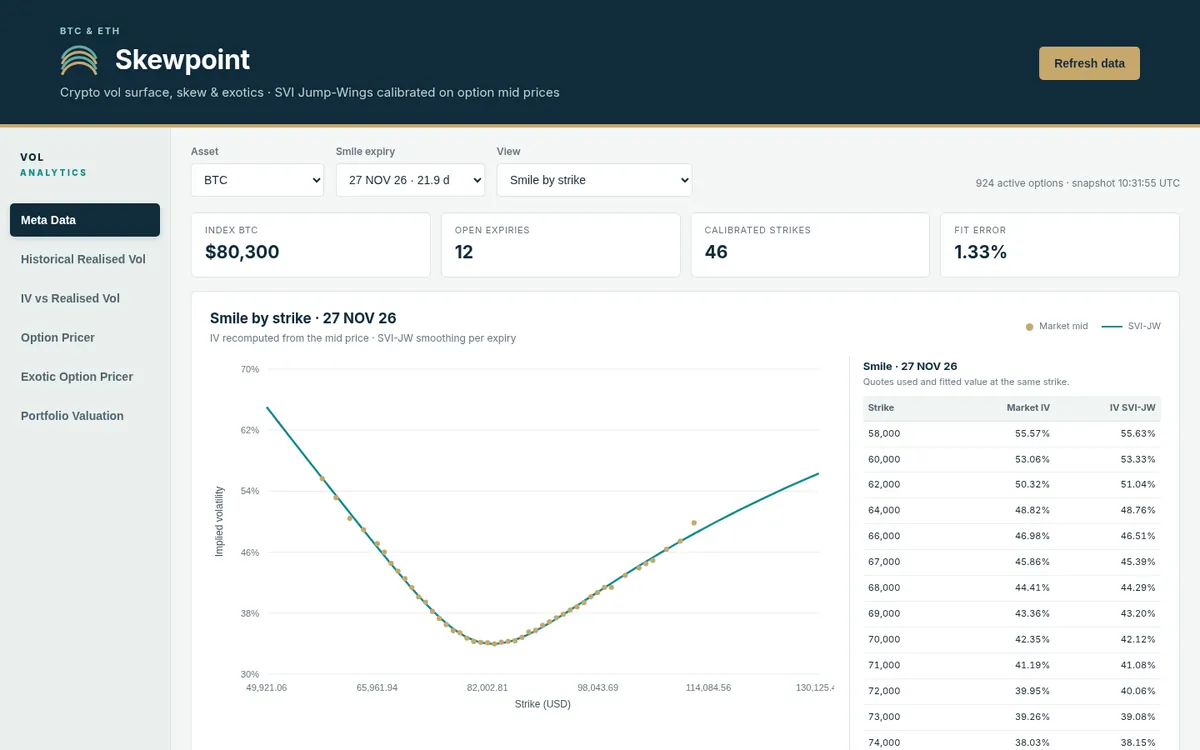
For every listed BTC and ETH expiry, Skewpoint takes live option quotes, recomputes the mid implied volatility from bid and ask prices, and keeps at each strike the side with the tightest usable spread; quotes that are too wide are left out of the fit. Each expiry is then calibrated with an SVI Jump-Wings (SVI-JW) curve — five parameters: ATM variance, ATM skew, put wing, call wing and minimum variance — fitted on total variance. SVI is the standard parametrisation for equity and crypto smiles because it fits the wings well and keeps the surface smooth.
Standard tenors (1D, 1W, 2W, 1M, 2M, 3M, 6M, 9M, 12M) are interpolated in total variance at constant delta between listed expiries; a tenor beyond the last listed expiry is extrapolated and flagged.
Smile, skew and term structure
Read each smile by strike or by delta (call-equivalent), compare smiles across expiries or tenors, and view the ATMF term structure. ATMF follows the market convention: the delta-neutral straddle (DNS) strike, where the call delta on the forward is 0.5. The tenor table gives, for each standard tenor, the forward, ATMF vol and the skew measures traders quote:
- Risk reversal (RR) 25Δ and 10Δ = IV put − IV call — positive when puts are bid, the usual sign of downside fear.
- Butterfly (Fly) 25Δ and 10Δ = (IV put + IV call)/2 − ATMF — how expensive the wings are versus the at-the-money vol.
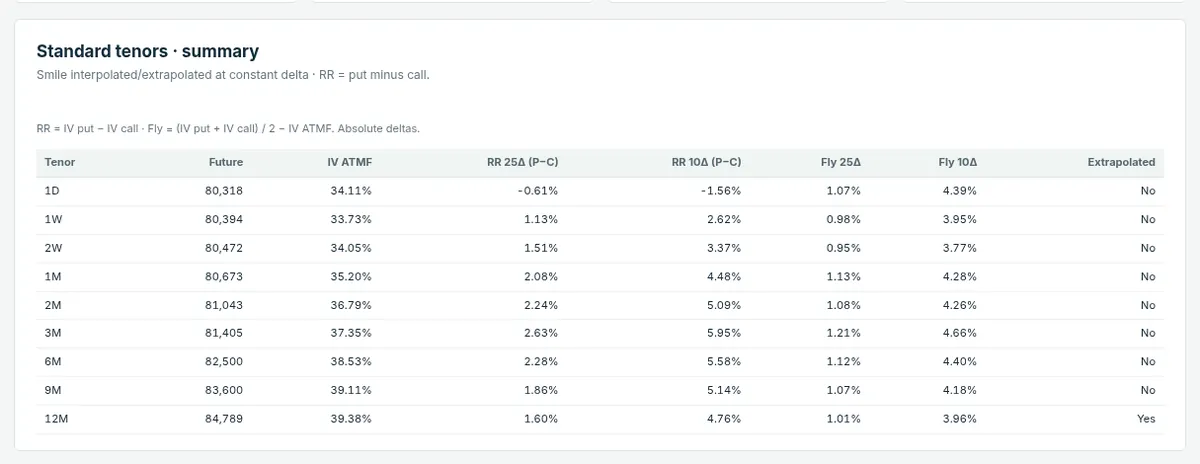
A full table of every smile from 1Δ to 99Δ, by expiry and by tenor, is also shown on the surface page.
Historical realised vol and IV vs RV
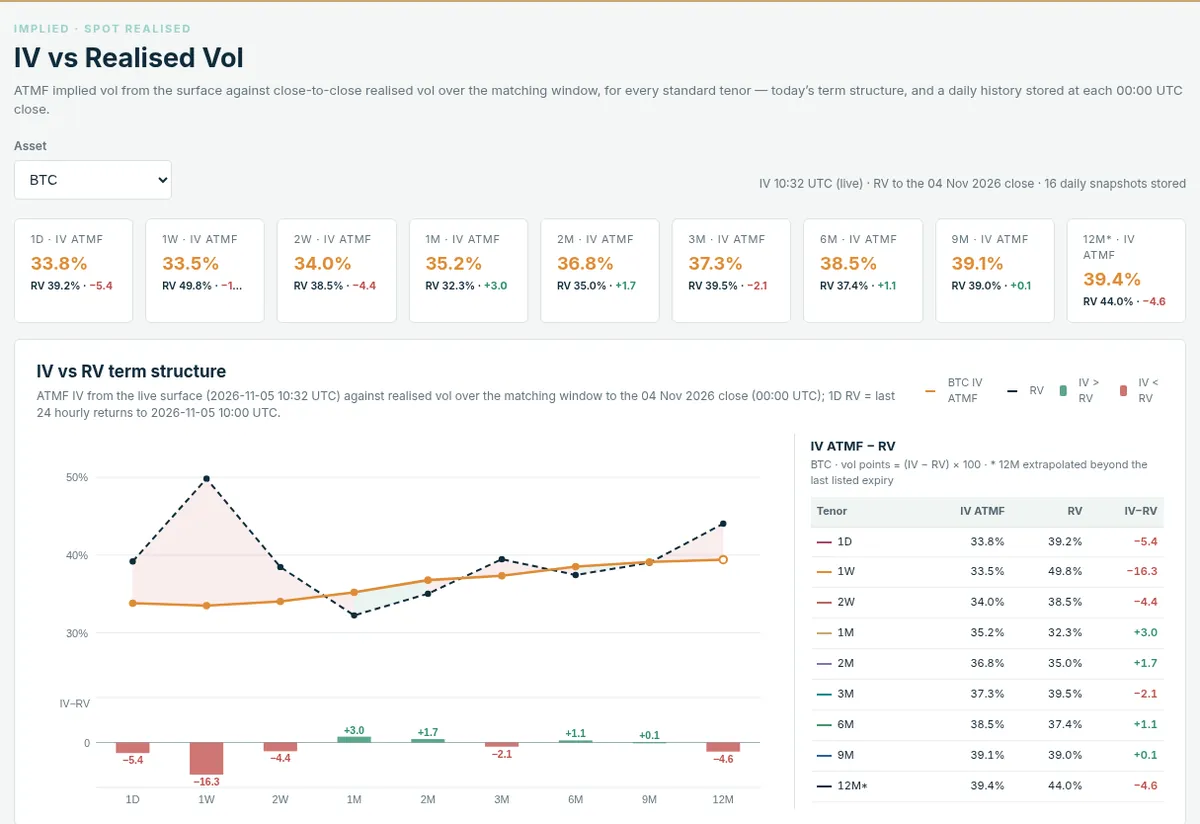
Implied vol only means something next to realised vol. The Historical Realised Vol page computes close-to-close realised volatility for BTC and ETH over 1D to 12M windows, annualised with √365 because crypto trades every day, with today’s value ranked against its own history (percentiles and a vol cone) and daily history back to 2015 for BTC and 2016 for ETH.
The IV vs Realised Vol page puts today’s ATMF implied vol next to the realised vol of the matching window for every tenor, shows the spread in vol points, and keeps a stored daily snapshot of the surface (ATMF, risk reversals, butterflies and SVI-JW parameters) at each 00:00 UTC close, downloadable as CSV.
Who it’s for
Traders who want to see the BTC skew and the ETH term structure at a glance, quants who need clean, calibrated vols for their own models, and anyone selling or buying volatility who wants to know whether implied vol is rich or cheap versus realised. The same surface prices every option in the option pricer, the portfolio valuation and the risk analysis.
Frequently asked questions
What is the Bitcoin implied volatility surface?
It is the implied volatility of BTC options across strikes (the smile) and maturities (the term structure). Skewpoint calibrates it live from option mid prices with an SVI-JW curve per expiry.
What do the 25-delta risk reversal and butterfly measure?
The 25Δ risk reversal is the implied vol of the 25-delta put minus the 25-delta call: it measures skew. The 25Δ butterfly is the average of the two minus the ATMF vol: it measures how expensive the wings are. Skewpoint shows both at 25Δ and 10Δ for every tenor.
Which tenors are available?
1D, 1W, 2W, 1M, 2M, 3M, 6M, 9M and 12M, interpolated from listed expiries in total variance at constant delta; extrapolated tenors are flagged. Every listed expiry is also available.
How is ATMF defined?
As the delta-neutral straddle (DNS) strike — the market convention — where the forward call delta is 0.5.
How is realised volatility calculated?
Close-to-close log returns on daily UTC closes, sample standard deviation over the tenor window (7 days for 1W up to 365 days for 12M), annualised with √365. 1D uses the last 24 hourly returns.
Can I download the data?
Yes. Approved users can download realised vol history and the stored daily IV snapshots (ATMF, risk reversals, butterflies, SVI-JW parameters) as CSV.
Try Skewpoint free
Access is free. Request it with your name and email and you are in straight away — no card, no trial clock.