 Skewpoint
 › Crypto option risk analysis
Crypto option risk analysis
Crypto option risk analysis — stress, barrier and VaR for a BTC & ETH options book
A tool for option risk analysis that revalues your whole crypto options book under stress: a spot × vol grid, a barrier ladder, and historical-simulation VaR and Expected Shortfall over three years of bitcoin and ether moves.
Free · instant access · runs in your browser
Full revaluation, not a Greek approximation
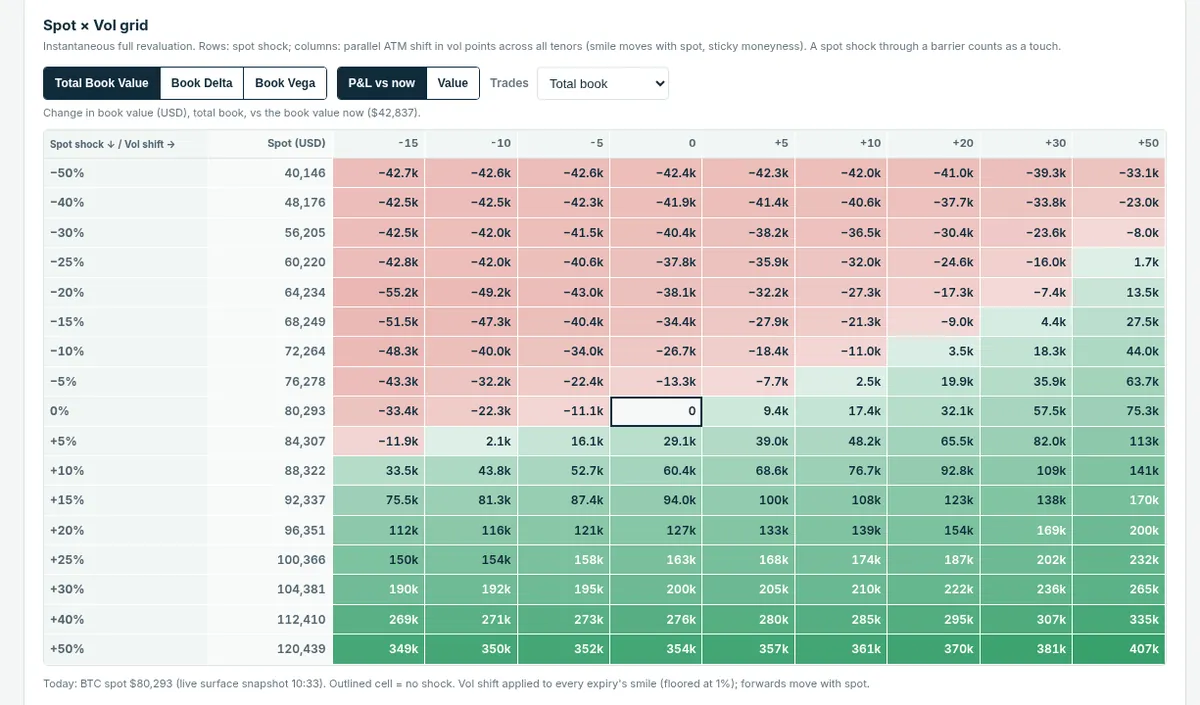
Delta and vega tell you what happens for a small move. Crypto moves are not small, and books with barriers and digitals change shape fast. Skewpoint’s risk analysis reprices every trade in the book under each scenario with the same pricers used for the portfolio valuation: vanillas through the option pricer and exotics through the exotic pricer. In a scenario, spot and every forward move together, the smile keeps its shape in moneyness (sticky moneyness), and a vol shift is added to every point of the surface, with a floor at 1%. A spot shock through a barrier counts as a touch. BTC and ETH books are analysed separately.
Spot × vol grid
The grid shocks spot from −50% to +50% (17 rows) and volatility from −15 to +50 vol points (9 columns). Switch the output between total book value or P&L versus now, book delta in coin, and book vega in USD per vol point, for the whole book or one product type. The heat map shows immediately where the book loses money — a short-gamma book bleeds on both sides of spot, a short-vega book in the right-hand columns.
Barrier ladder
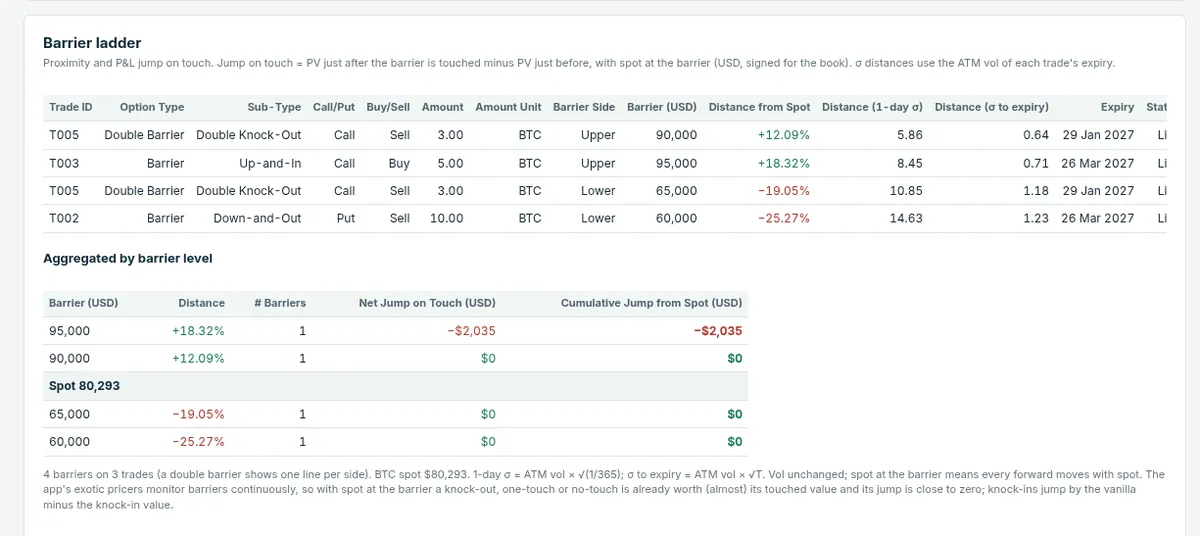
For every barrier in the book (double barriers on each side), the ladder shows the distance from spot in percent, in one-day standard deviations and in standard deviations to expiry, the value now, the value with spot at the barrier and after the touch, and the jump. Levels are aggregated and accumulated outward from spot, so you can see the total jump risk you face as the market walks toward a cluster of barriers.
Historical-simulation VaR and Expected Shortfall
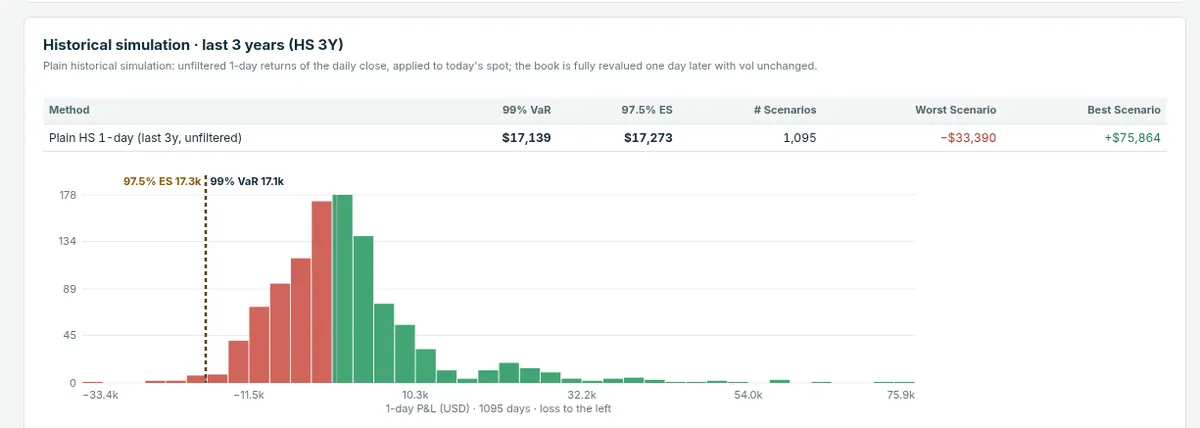
Skewpoint applies the last three years of daily returns (1,095 scenarios) of the underlying to today’s spot and fully revalues the book one day later in each scenario, volatility unchanged. From the resulting P&L distribution it reports the 1-day VaR at 99% and the Expected Shortfall at 97.5% (losses shown as positive numbers), with the worst and best ten scenarios and their dates. The tail days that decide VaR and ES are revalued exactly at their own spot.
Who it’s for
Risk managers who need a stress grid and a VaR number for a crypto options book without building their own models, traders who want to see their barrier and gap exposure before the market finds it, and anyone reporting risk on BTC and ETH option positions. Load your book on the portfolio valuation page and the analysis runs automatically after pricing.
Frequently asked questions
What risk analysis does Skewpoint run on a crypto options book?
Three views, all by full revaluation: a spot × vol grid (spot −50% to +50%, vol −15 to +50 points), a barrier ladder showing the value jump at each barrier, and a one-day historical-simulation VaR at 99% and Expected Shortfall at 97.5% over the last three years.
How is the historical VaR calculated?
Each of the last 1,095 daily returns of BTC or ETH is applied to today’s spot; the book is fully revalued one day later at that spot with volatility unchanged. VaR 99% is the 1st percentile loss; ES 97.5% is the average loss beyond the 2.5th percentile.
Does it handle barrier options in stress tests?
Yes. Barriers, touches and double barriers are repriced in every scenario, and a spot shock through a barrier is treated as a touch. The barrier ladder shows the jump in value at each level.
What does the spot-vol grid show?
Total book value or P&L versus now, book delta in coin, or book vega in USD per vol point, for every combination of spot shock and parallel vol shift — for the whole book or a single product type.
How is volatility shocked?
A parallel shift in vol points is added to the whole surface, with the smile kept in moneyness and a floor at 1% vol.
Are BTC and ETH risks combined?
No. The BTC book and the ETH book are analysed separately, so each coin’s risk is read on its own.
Try Skewpoint free
Access is free. Request it with your name and email and you are in straight away — no card, no trial clock.